A mysteriously rare and declining species
X̱áay (yellow-cedar) is dying in much of its maritime, more southerly range, such as Lg̱éex̱’i, (Peril Strait) near Sitka. Meanwhile, throughout our home in Áak’w & T’aaḵú Aaní, the scattered, seemingly random stands appear healthy, often surrounded by ‘halos’ of knee-to-head-high saplings. But that’s small cause for optimism; the mature stands have ‘static’ boundaries, unchanged for 200 years. As John Krapek & Brian Buma summarized in 2018, range-wide, “yellow-cedar’s trailing edge is approaching its leading edge.”
Soils researcher Jessica Murray is in town to revisit some instrumented yellow-cedar plots, collecting samples and downloading temp & moisture data. Cathy and I joined her for a day on the Moller trail.
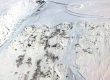
Every new outdoor adventure is another opportunity, while drying out at home from another 1.5-incher, for ‘virtual explorations’ in the spectacular 2023 LiDAR that we added to our cartographic library not long ago. Unlike the 2013 LiDAR we’ve been using for a decade, this mission goes right to surrounding mountaintops. Here’s a subalpine flyover of ‘Cedar Ravine’ in the .las pointcloud.
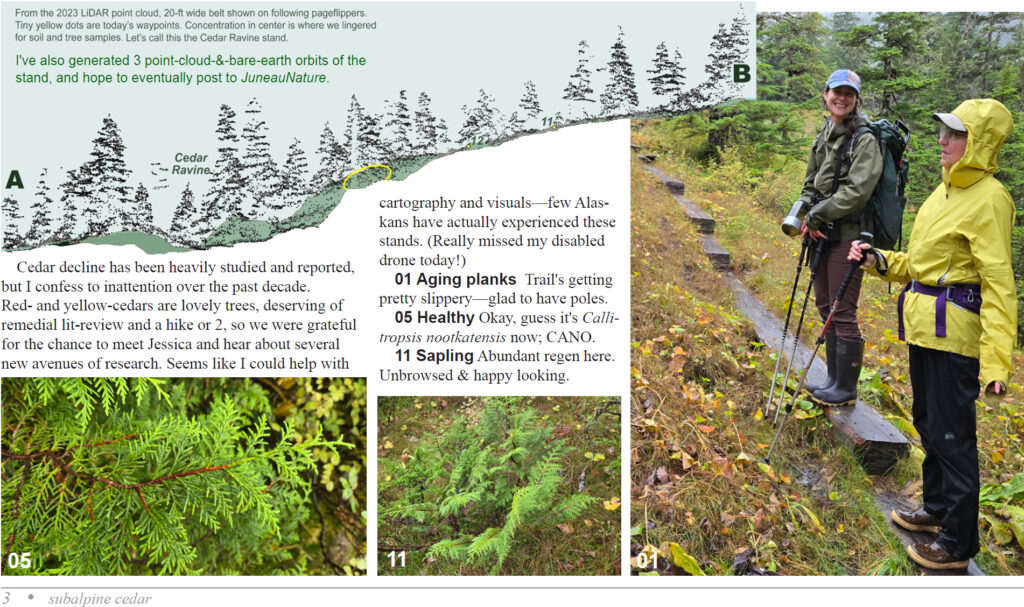
sample spread from my 10-page journal
As described in today’s journal, LiDAR has potential to someday assist with remote detection and mapping of this poorly understood species. Back home after the walk, my attempts to locate the small trees we ground-truthed in .las profiles were inconclusive. It’ll probably require a denser pointcloud. That could be delivered at fine scale right now from lower-elevation drone surveys. But we also badly need archipelago-wide maps of both red- and yellow-cedar that have been intensively logged—and these will probably have to await traditional plane-based LiDAR with more powerful sensors. As if climate change wasn’t challenging enough, x̱áay and laax̱ (redcedar) are primary targets of today’s timber industry. Scientists aren’t the only ones ‘chasing’ these trees.
For now, at least, the pointcloud is an engaging way to visualize the character of these short-tree forests and woodlands. This makes me want to walk and ‘fly’ all eleven of our yellow-cedar groves.
For notes on our coring and sampling, download 8mb pdf here